Pad Thai sauce
Homemade Pad Thai sauce from three ingredients: tamarind, fish sauce and palm sugar. The ratio, how to make tamarind purée from a block, and what to swap if you can’t find something.
Jump to recipe →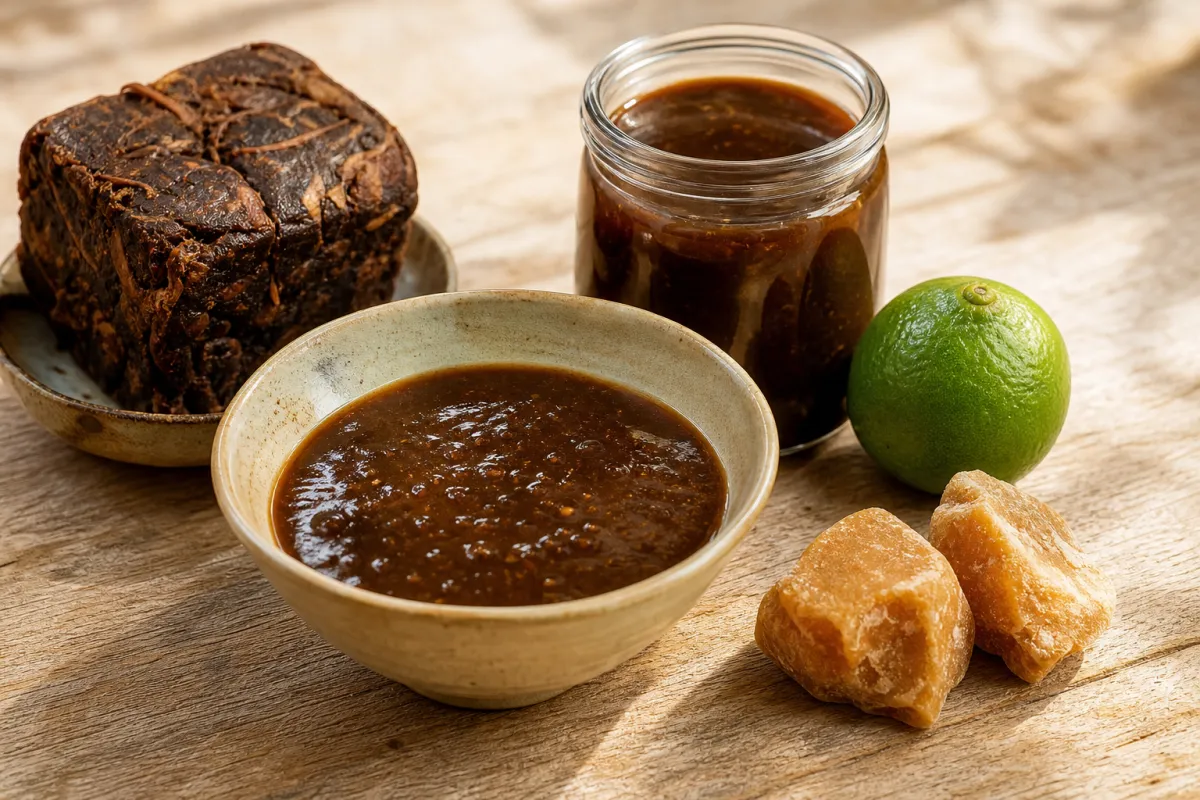
The recipe, step by step
The sauce is the heart of Pad Thai. Shop-bought jars are often too sweet and thickened with starch, while a homemade sauce takes 5 minutes. The basis is a ratio of roughly 3 : 2 : 2.5 (tamarind : fish sauce : sugar) — a starting point only, because the strength of different brands varies a lot.
Ingredients
- 90ml
- 60ml
- 70g
* Tamarind purée, not concentrated paste. Always follow your product label.
Method
- 01
If your palm sugar is a hard block, chop or grate it so it dissolves quickly.
- 02
Put the tamarind purée and fish sauce in a small pan and add the sugar.
- 03
Warm over a low heat for 2–3 minutes, stirring, until the sugar has completely dissolved. Don’t boil it for long — the sauce shouldn’t reduce.
- 04
Taste, ideally once it has cooled a little. It should be clearly sour, salty and sweet at once, with no single flavour dominating. Too sour: more sugar. Too sweet: more fish sauce or a little more tamarind.
- 05
Use straight away or pour into a clean jar and keep in the fridge.
Cooking tips
For 2 portions of Pad Thai (160 g dried noodles) you need about half this batch, roughly 100 ml.
You can make it ahead: in a sealed jar in the fridge it keeps for up to 5 days. Stir before using.
If it has thickened in the fridge, loosen it with a spoonful of warm water.
Tamarind purée from a block
In Asian shops tamarind is usually sold as a pressed block with seeds. Cut off 50 g, pour over 150 ml hot water and leave for 15 minutes. Squash it with your fingers or a fork, then push it through a sieve with a spoon. You’ll get about 120 ml of thick purée — enough for this batch.
Purée versus concentrate
Jars labelled “tamarind concentrate” are dark, very thick and several times stronger than purée. If that’s what you have, start with 1 tbsp diluted with 3 tbsp water and add more gradually, tasting as you go.
Swaps
Light soft brown sugar can replace palm sugar — the sauce will be a little less caramel-like. For a vegetarian sauce, use light soy sauce or tamari instead of fish sauce (start with less; regular soy sauce contains gluten). In an emergency, lime juice with brown sugar can stand in for tamarind, but the flavour will be different.
Ketchup, oyster sauce and peanut butter don’t go in the classic sauce. They turn up in many online recipes, but they make a different dish.
Frequently asked questions
How much sauce per portion of Pad Thai?
About 50 ml of sauce per portion, which is 80 g of dried rice noodles.
Is Pad Thai sauce spicy?
No. Heat is added separately — with chilli flakes at the table or fresh chilli in the wok.
How long does homemade Pad Thai sauce keep?
Up to 5 days in a clean, sealed jar in the fridge.