Chicken Pad Thai
Juicy strips of chicken, rice noodles in tamarind sauce, egg, bean sprouts and peanuts. The chicken is fried on its own and goes back in at the end, so it never dries out.
Jump to recipe →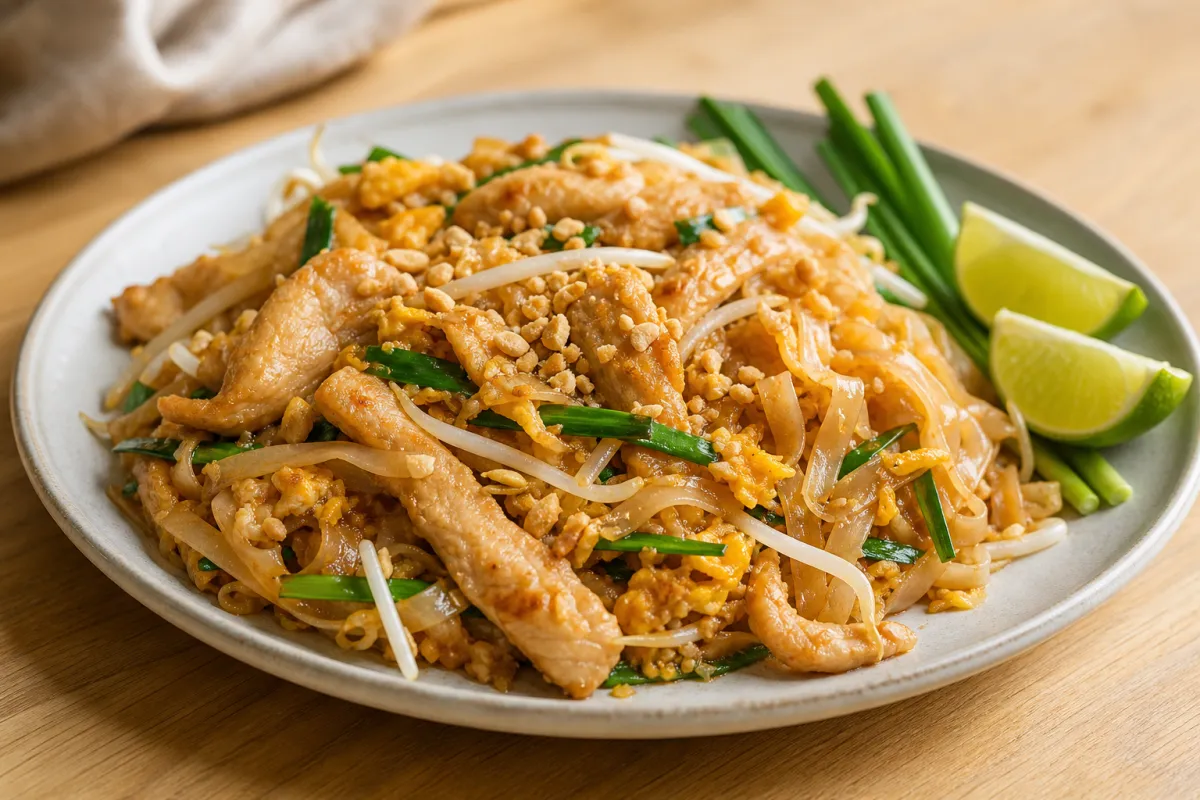
The recipe, step by step
Chicken Pad Thai is the version most people cook at home: chicken is easy to get hold of and its mild flavour suits the sweet-sour sauce. Boneless thighs are the best choice because they stay juicy over a high heat. Breast works too, as long as you slice it thinly and don’t overcook it.
Ingredients
- 160g
- 250g
- 45ml
- 30ml
- 35g
- 45ml
- 2
- 2
- 1
- 120g
- 30g
- 30g
- 1
* Tamarind purée, not concentrated paste. Always follow your product label.
Method
- 01
Soak the noodles in lukewarm water for 25–30 minutes until pliable but still slightly firm in the middle. Drain.
- 02
Cut the chicken into strips about 5 mm thick and mix with 1 tsp fish sauce. Wash the board and knife after handling raw chicken.
- 03
Warm the tamarind, fish sauce and sugar until the sugar dissolves. Taste and adjust.
- 04
Heat the wok over a high heat with 2 tbsp oil. Fry the chicken in a single layer for 4–5 minutes, stirring, until browned and completely white in the centre (75 °C if you have a thermometer). Lift out onto a plate.
- 05
Add the rest of the oil, the garlic and shallot and stir-fry for 20–30 seconds.
- 06
Add the noodles and the sauce and toss for 2–3 minutes. If the noodles are still hard and the wok is dry, add water 2 tbsp at a time.
- 07
Push the noodles to one side, crack in the eggs, let them start to set, then scramble and toss through the noodles.
- 08
Return the chicken with any juices from the plate, add most of the bean sprouts and the chives and toss for 30–60 seconds until the chicken is piping hot.
- 09
Serve straight away with peanuts, lime and raw bean sprouts.
Cooking tips
Thighs are more forgiving than breast. If you use breast, slice it thinly across the grain and don’t cook it any longer than needed.
Fry the chicken in a single layer. If there’s too much for your pan, do two batches — otherwise it releases liquid and stews instead of browning.
The chicken only goes back into the wok at the end to heat through. That’s what keeps it juicy.
Thigh or breast?
Boneless thighs have a little more fat and cope well with the fierce heat of a wok. Breast is leaner and dries out faster, but cut into thin strips and taken off the heat as soon as it’s no longer pink, it’s good too. Either way, the chicken must be cooked all the way through.
Adding tofu
Traditional Pad Thai often includes cubes of fried tofu. If you like, cut the chicken to 180 g and add 100 g firm tofu, fried until golden before the chicken. Remember that tofu is soya — important for allergies.
Leftover roast chicken
Pad Thai is a good way to use up leftover roast chicken. Skip the frying step, shred or slice the cooked meat and add it with the bean sprouts. Heat it until piping hot all the way through, but no longer, or it will turn dry.
Frequently asked questions
How long do you cook chicken for Pad Thai?
Thin strips need 4–5 minutes over a high heat, until completely white in the centre. A thermometer should read 75 °C.
Do I need to marinate the chicken?
No. A teaspoon of fish sauce mixed in 10–15 minutes before cooking is enough to season it.
Can I make chicken Pad Thai for 4?
Yes, but cook it in two batches of 2 portions. A crowded wok steams the noodles and they turn mushy.